Start with the watch as your anchor
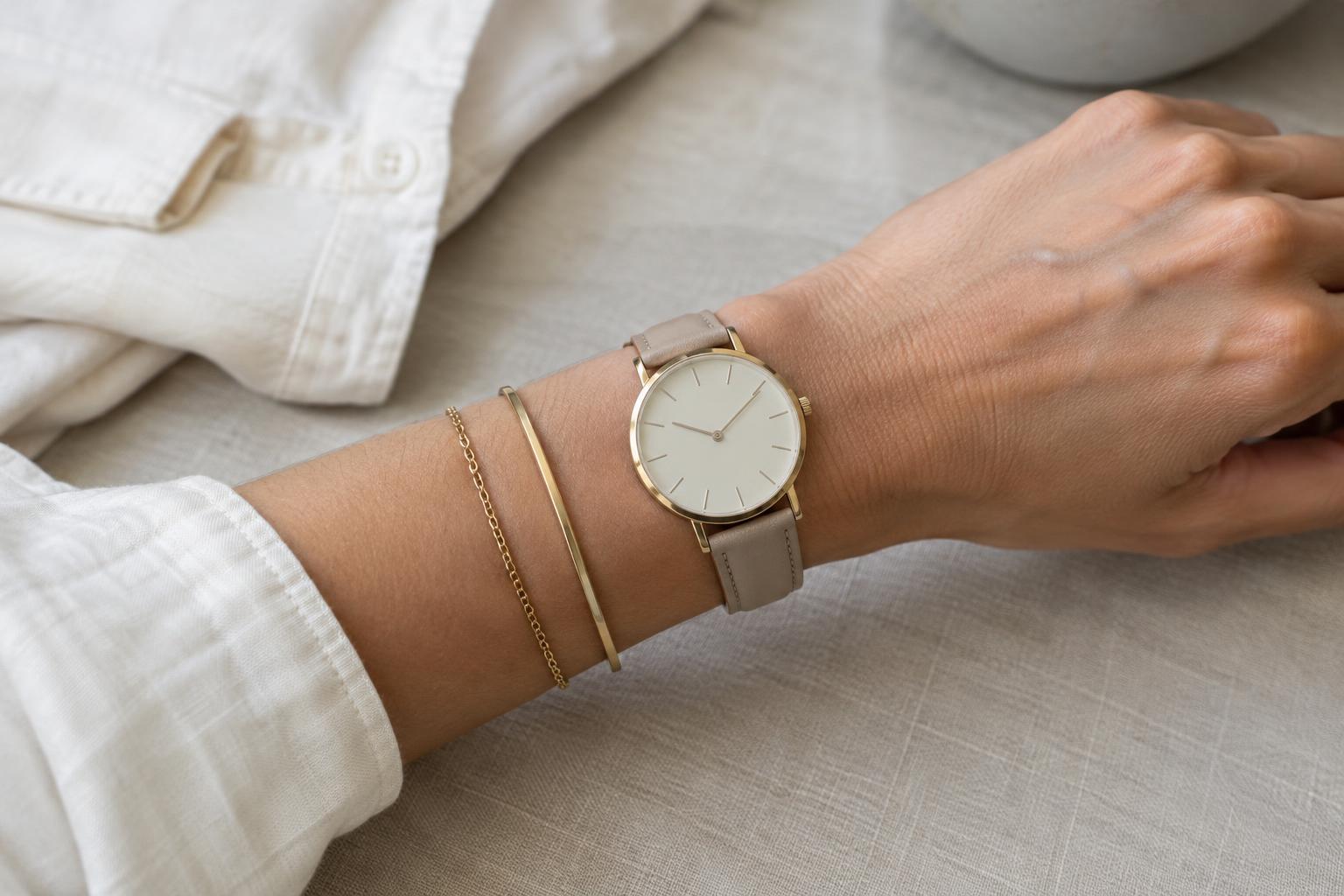
Put your watch on first, then assess how much space remains on your wrist. Its case and strap set the scale for everything beside it. A watch with a large face or wide strap often needs only one slim bracelet for company. A smaller watch can sit comfortably alongside two delicate pieces, provided they do not bunch up when your arm moves.
You do not need to match every detail. Instead, decide which piece should draw the eye. If your watch has a colorful face, textured strap or bold case, keep the bracelets quieter. If the watch is simple, a bracelet with an interesting shape can add contrast without making the whole grouping feel busy. Leave some visible skin between the stack and your hand so the accessories look intentional rather than squeezed into place.
Choose shapes that sit well together
The easiest bracelet to pair with a watch is one that occupies little space and moves independently. A fine chain, narrow cuff or slim beaded bracelet can add detail without competing with the watch case. If you prefer a wider bracelet, try wearing it on the opposite wrist; two broad pieces side by side can make it harder to see either one clearly.
Pay attention to where each piece naturally rests. A loose chain may slide over the watch face, while a rigid bangle may knock against the case as you move. That does not mean the combination is off-limits, but it is worth trying it on for a few minutes before leaving home. Fasten each piece at a comfortable setting, raise and lower your arm, and notice whether anything catches, twists or presses into your hand.
Build a simple stack, then edit it
A reliable starting point is a watch plus one bracelet. Place the bracelet on the side of the watch closer to your elbow, where it is less likely to slip between the watch and your hand. If the pairing looks too sparse for your taste, add one more thin piece and reassess. Keeping the additions gradual makes it easier to spot the moment the wrist starts to feel crowded.
Varying texture can make a small stack more interesting than adding more items. For example, a smooth metal watch can sit beside a fine chain, or a leather strap can pair with a polished cuff. Mixed metals can also work when one finish leads and the other appears as a small accent. If several bracelets have large charms, thick links or prominent clasps, choose just one of them to wear next to the watch and give its details room to show.
Let clothing and daily tasks guide the choice
Sleeves change how a wrist stack looks and feels. Under a close-fitting cuff, a low-profile bracelet is usually easier to manage than a rigid bangle or a cluster of charms. With short sleeves or a loose cuff, you have more visible space to play with. Try the complete outfit before deciding: a pairing that looks balanced on a bare arm may disappear under a sleeve or catch on its edge.
Think about what your hands will be doing, too. If you spend much of the day typing, carrying bags or working with your hands, fewer pieces may be more comfortable. You can still create a finished look with a watch and one bracelet that stays in place. For an occasion when you want more decoration, you can add another piece or move a statement bracelet to your other wrist.
Check the fit and finish before you go
Once your stack is assembled, look at it from the side as well as from above. The watch face should remain easy to see, and the bracelets should not pile onto its case every time you move. If they do, try a shorter bracelet, a different order or fewer pieces. A little movement can look relaxed; constant tangling usually means the grouping needs an edit.
Finally, consider how the materials meet. Pieces with hard edges may rub against a watch case or delicate strap, so separate them or wear them on opposite wrists if you want to limit contact. The goal is not a perfectly matched set. It is a combination that feels comfortable, works with your outfit and lets both the watch and your chosen bracelets have their own space.