Start with the space on your hand
Ring stacking is less about fitting as many bands as possible onto one finger and more about choosing which pieces should share the available space. Look at the distance between your knuckle and the base of each finger. A short stretch may feel better with one medium band or two slim ones, while a longer stretch may accommodate a wider ring alongside a narrow companion. The aim is to keep the stack from pressing into the knuckle when you bend your hand.
Before planning a combination, try each ring on by itself. Notice where it sits, whether it rotates, and whether an edge catches on the neighboring finger. A ring that feels fine alone can become awkward when another band pushes it higher. Treat your most comfortable piece as the starting point, then add only what fits around it.
Give different widths different jobs
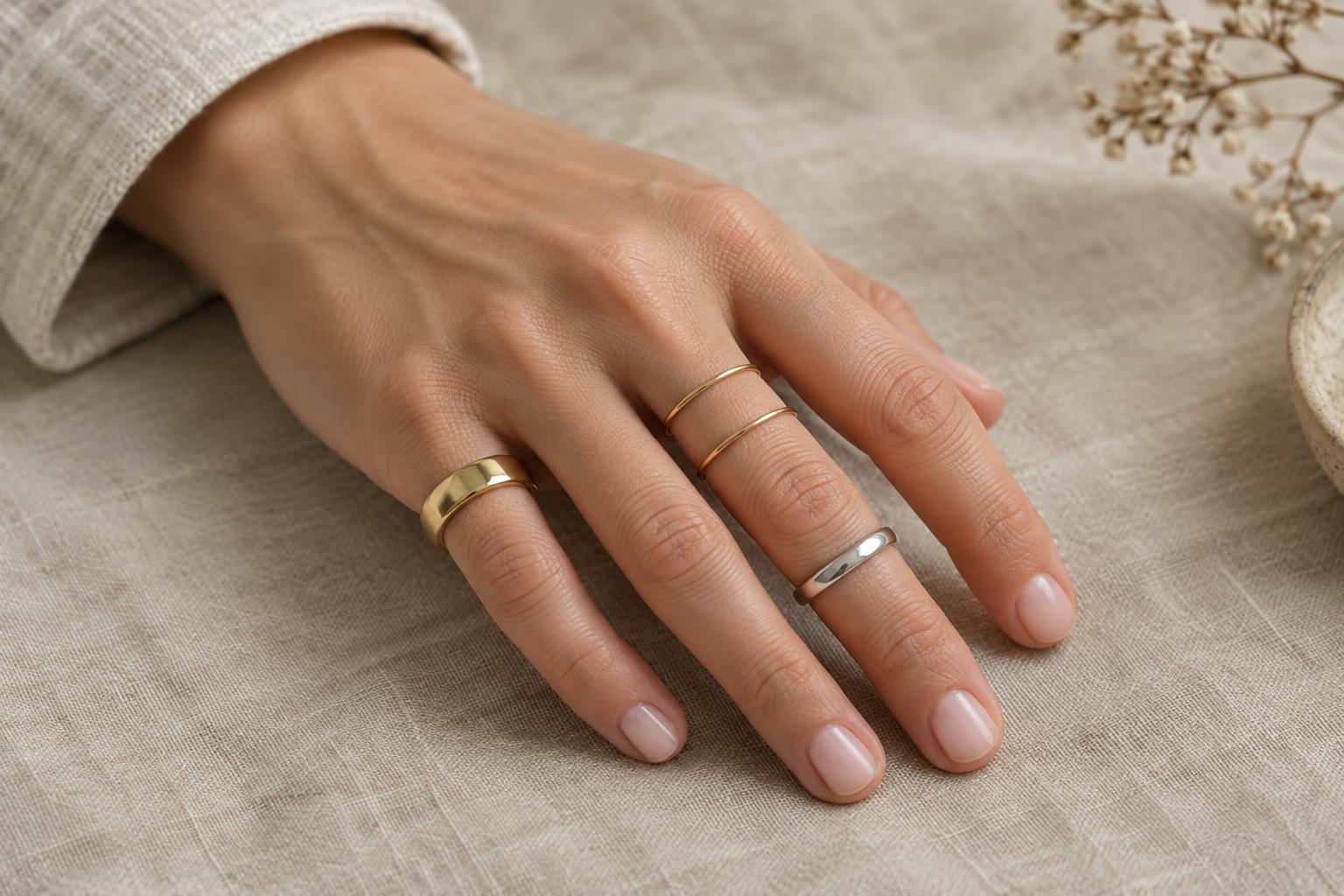
A useful starting formula is one wider anchor ring with one or two slim accents. The anchor gives the stack a clear focal point; the narrower bands add detail without using as much room. You can also reverse the emphasis: place several delicate bands on one finger and let a single wider ring stand alone on another. Neither approach requires matching sets.
Pay attention to the edges as well as the stated width. A flat, straight-edged band may sit closely against another flat band. A domed band, raised setting, or textured edge may need a little separation to avoid rubbing or making the rings tilt. If a decorative ring has a stone or other detail that projects outward, pair it with a band that does not crowd that detail. Try the arrangement in more than one order; moving a slim ring to the outside can change both its appearance and how it feels.
Balance the stack across your fingers
If one finger feels crowded, distribute the rings instead of removing all the visual interest. For example, a wide band on the middle finger can be balanced by a pair of slim bands on the ring finger. Leaving one finger bare gives the eye a pause and can make the chosen rings look more deliberate. There is no need to make both hands symmetrical; a simple band on one hand may be enough to complement a fuller arrangement on the other.
Consider what happens when adjacent fingers touch. Two bulky rings worn side by side may knock together as you walk, hold a bag, or type. Slim bands on neighboring fingers can create a similar layered look with less contact. If you like wearing a ring on your index finger, check how it feels when you grip a pen, phone, or handle. A placement that looks balanced in a still photograph may feel different during ordinary tasks.
Check comfort with your hand in motion
Once you have a stack you like, open and close your hand, spread your fingers, and pick up something you use often. The rings should move naturally with you rather than force your fingers apart or pinch when they bend. Check that you can remove each ring without a struggle. Finger size can vary over the course of a day, so a combination that is already uncomfortably snug is not a good one to rely on.
Stacked rings can also shift against each other. If one band keeps climbing over another, the widths, shapes, or fits may not work well together on that finger. Try wearing them separately, changing their order, or moving one to another finger. Comfort is a practical design constraint, not a compromise: a smaller stack that stays in place is easier to wear than a more elaborate one you constantly have to adjust.
Edit for the look you want to wear
After settling the fit, use finish and detail to bring the rings together. Repeating one element, such as a smooth surface, a similar metal tone, or a recurring shape, can make mixed widths feel connected. Contrast can work too: a plain wide band provides a quiet backdrop for a slim textured ring. Keep the most detailed pieces where they can be seen rather than burying them between heavier bands.
Make your final edit with your usual activities in mind. Rings with raised details may catch on knitwear, while broad bands may feel more noticeable during hands-on tasks. You might keep a simple two-ring combination for everyday wear and add a statement piece when it suits the occasion. The best stack is not the fullest one. It is the combination that looks intentional, leaves your fingers room to move, and is pleasant enough to keep on.