Start with the product, not the longest word
Before reading individual ingredients, decide what you want the product to do. A cleanser needs to remove makeup, sunscreen or everyday buildup comfortably. A moisturizer needs to feel pleasant enough that you will use it regularly. A sunscreen needs to be one you can apply as directed. This gives you a practical question to bring to the label: does the formula appear suited to the job and to your preferences?
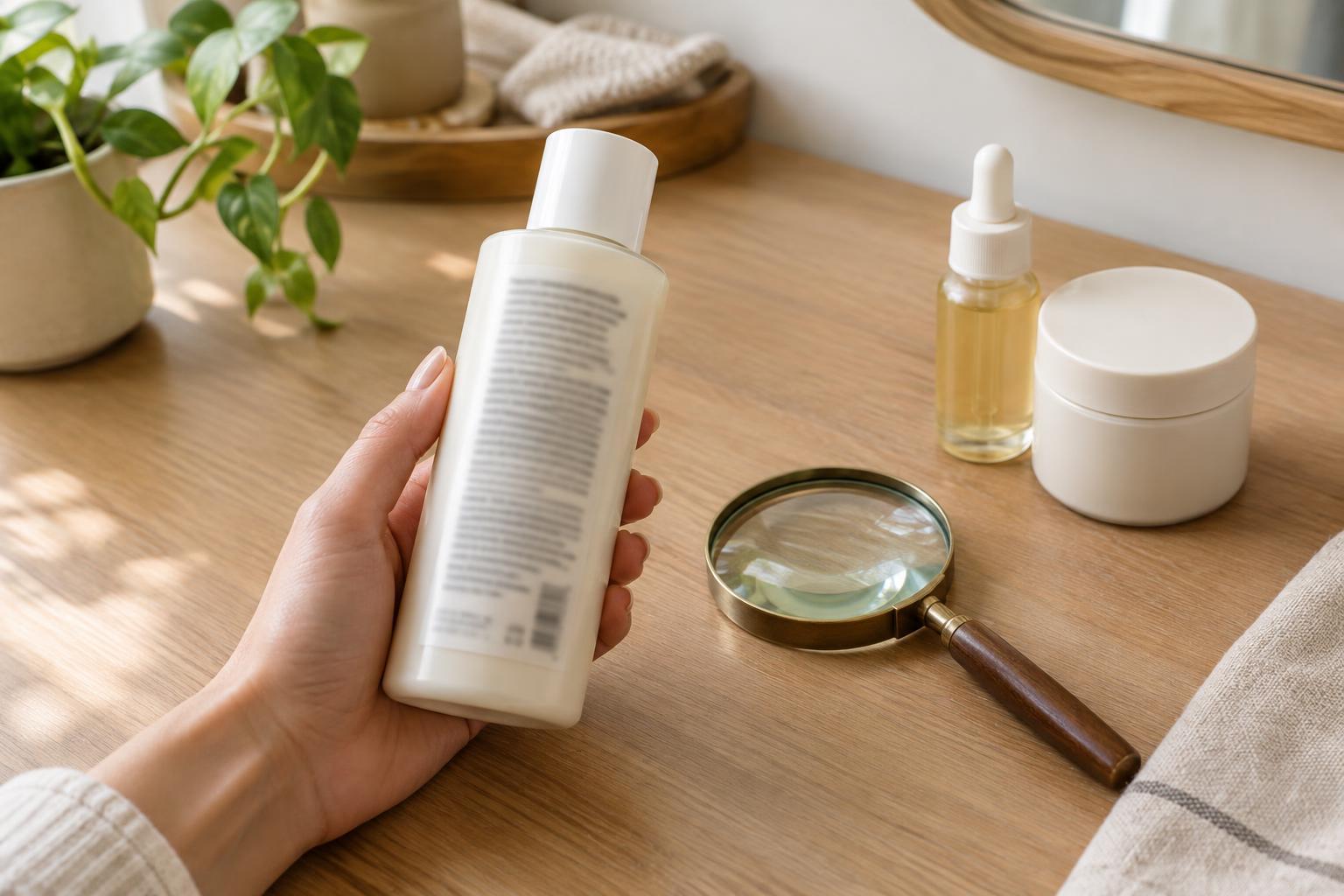
The ingredient list is only one part of that decision. The product’s directions tell you how it is intended to be used, while its texture and packaging may affect how well it fits your routine. You do not need to decode every chemical name to make a reasonable choice. Start by looking for a few ingredients or ingredient types that matter to you, then leave room for how the complete product feels in use.
Understand what ingredient order can—and cannot—tell you
Ingredients are generally listed by the amount used, with higher amounts appearing earlier. Rules for ingredients present at low concentrations can vary by market, so the final few names are not always a precise ranking. An ingredient near the beginning is likely a substantial part of the formula; one near the end may be present in a smaller amount. The list usually will not tell you exact percentages.
Order also does not tell you whether a product will suit your skin. An ingredient can serve a useful purpose at a small amount, and the way ingredients work together affects the finished texture. Likewise, a familiar ingredient near the top is not a guarantee that a product will feel comfortable. Treat the list as a set of clues rather than a scorecard.
Look for roles instead of memorizing names
Many skincare ingredients have ordinary formulation jobs. Humectants, such as glycerin, help attract water. Emollients help a product feel smooth and soften the feel of skin. Occlusive ingredients, such as petrolatum, can help reduce moisture loss. In a cleanser, surfactants help lift oils and other material so they can be rinsed away. Preservatives help protect products from spoilage during normal use. Seeing one of these names is not, by itself, a reason to celebrate or worry.
Some names are worth learning because they connect to your own preferences. If you dislike a strongly scented product, look for terms such as fragrance or parfum, while remembering that other ingredients may also have a scent. If you already know a particular ingredient does not agree with you, check for it directly. Keeping a short personal list is more useful than trying to label every unfamiliar word as good or bad.
Read featured ingredients in context
The front of a package may spotlight an ingredient, but the full list can help you see the broader formula around it. A moisturizer featuring hyaluronic acid, for example, may also contain other humectants, emollients and texture-building ingredients. These supporting ingredients are not filler simply because they are less prominent in the product name. They help make the product usable.
Be careful about judging a featured ingredient solely by its position on the list. Without its concentration, the complete formula and the product’s intended use, you cannot reliably predict the result from placement alone. It is more helpful to ask whether the ingredient makes sense for the product’s purpose and whether the directions fit the routine you want to keep.
Use the list to make a manageable choice
When comparing products, narrow the decision to two or three priorities: perhaps an unscented option, a texture you enjoy and compatibility with products you already use. Read the directions, scan for ingredients you prefer or avoid, and check that the product matches the step you are shopping for. This is usually more manageable than comparing every line of two long lists.
If your skin is easily bothered by new products, introduce one new item at a time and pay attention to how your skin feels. Stop using a product if it causes discomfort. An ingredient list cannot predict every individual response, but it can help you ask better questions and remember what has worked for you. The goal is not to become a formulation expert; it is to make informed choices without turning a simple routine into a research project.