Start with one piece you want to wear
Mixing metals is easier when you begin with a piece you already want in the outfit: a favorite watch, a pair of silver-tone hoops, or a gold-tone pendant. Treat it as the focal point, then choose other jewelry that supports it. This is more useful than trying to make every ring, clasp, and bag detail match before you get dressed.
Notice the focal piece’s size and visual weight. A wide cuff or large earrings will draw attention, while a fine chain may barely register from a distance. If your main piece is bold, let the second tone appear in smaller accents. If the main piece is delicate, you can use a more even mix without either tone taking over.
Repeat each tone so the mix feels deliberate
One gold-tone item among several silver-tone pieces can look accidental, particularly when the pieces sit far apart. Try echoing the smaller presence somewhere else: a gold-tone ring can connect to gold-tone earrings, or a silver-tone watch can relate to a silver-tone necklace clasp or bracelet. The repetitions do not need to be identical. They simply give the eye another place to find each color.
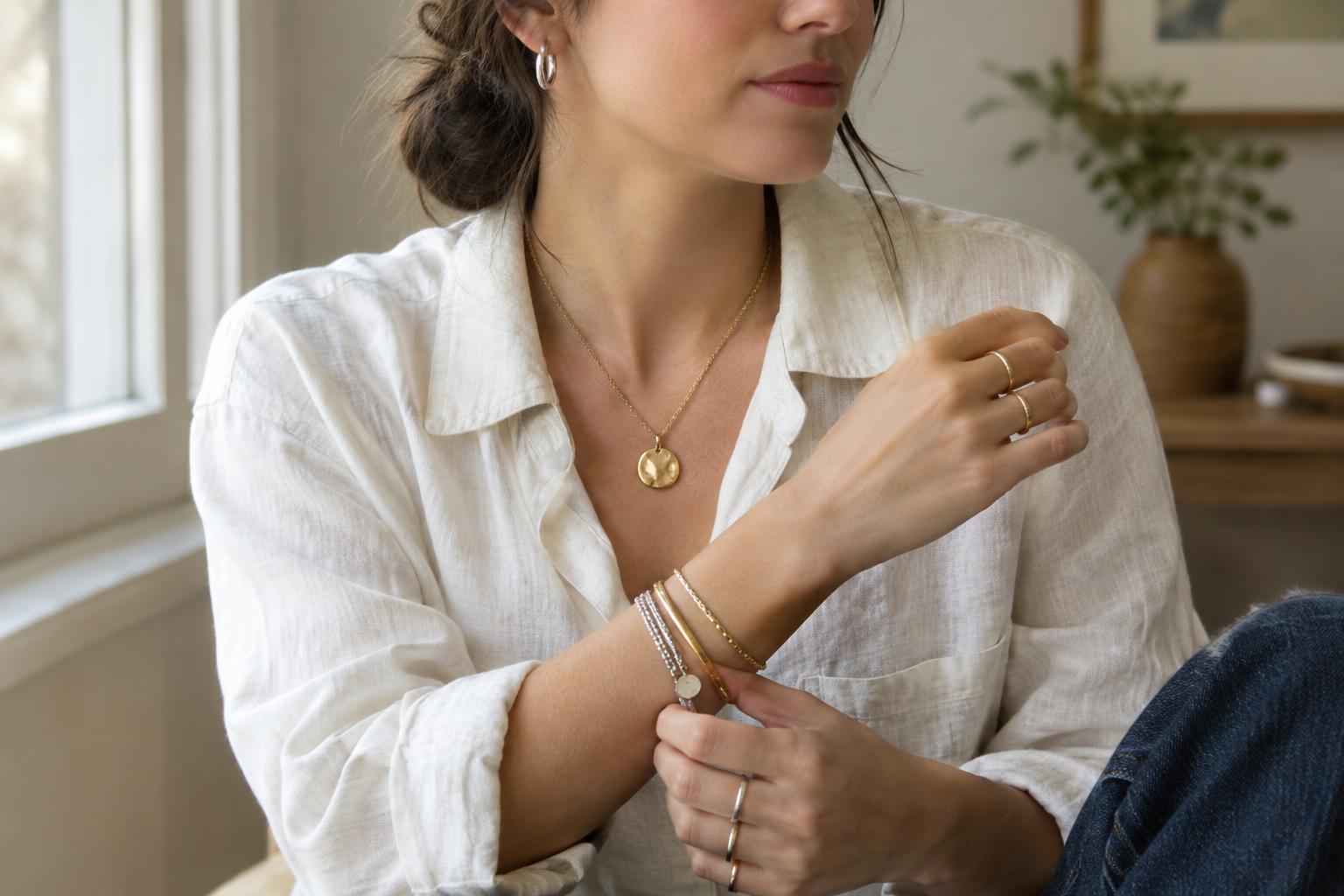
You can also create a bridge by wearing both tones in one area. Stack a slim gold-tone bracelet beside a silver-tone watch, layer two short necklaces in different tones, or wear mixed rings across one hand. Keeping the pieces near each other makes the combination easy to read. After that, you can spread the tones around the outfit without needing a perfectly even count.
Use scale and finish to tie pieces together
Metal color is only one part of how jewelry looks. Shape, thickness, and finish can provide a stronger connection. For a quiet combination, pair pieces of similar scale, such as two fine chains or a set of slim bands. For a bolder look, repeat a shape instead: rounded hoops, a curved pendant, and a smooth dome ring can feel related even when their tones differ.
Finishes matter, too. Bright, polished pieces tend to look cohesive with other polished pieces, while matte or brushed surfaces often pair comfortably with each other. This is a guideline, not a requirement. If you like contrast, try making one textured or vintage-looking piece the focus and keeping the rest simpler. Step back from the mirror to check whether the contrast reads as a choice rather than a cluster of competing details.
Let your clothes and accessories set the pace
A simple outfit gives mixed jewelry room to stand out. With a plain knit, shirt, or dress, you might layer several pieces or combine a substantial watch with earrings in the other tone. A patterned top, embellished neckline, or detailed collar may need less: one pair of earrings and a ring could be enough. Consider the space around each piece as well as the pieces themselves.
Hardware on bags, belts, shoes, and glasses can join the mix, but it does not have to dictate every jewelry choice. If your bag has a gold-tone buckle and your watch is silver-tone, a small gold-tone earring or ring can connect them. If the hardware is subtle, you may not need to address it at all. Treat it as one visible detail in the outfit, not a rule you have to obey.
Try a simple combination, then adjust
For an easy starting point, choose one tone for the most noticeable item and use the other in two smaller places. You might wear silver-tone hoops with a fine gold-tone necklace and ring, or a gold-tone watch with silver-tone studs and a slim band. Another option is to keep all the jewelry delicate and let both tones appear in a layered necklace stack.
Before leaving, look at the whole outfit rather than inspecting each piece on its own. If one area feels crowded, remove a layer or move the second tone elsewhere. If the mix feels disconnected, add a small repeated detail. There is no required ratio of gold to silver: the aim is an outfit that feels comfortable, balanced, and recognizably yours.