Start with the way you use your mirror
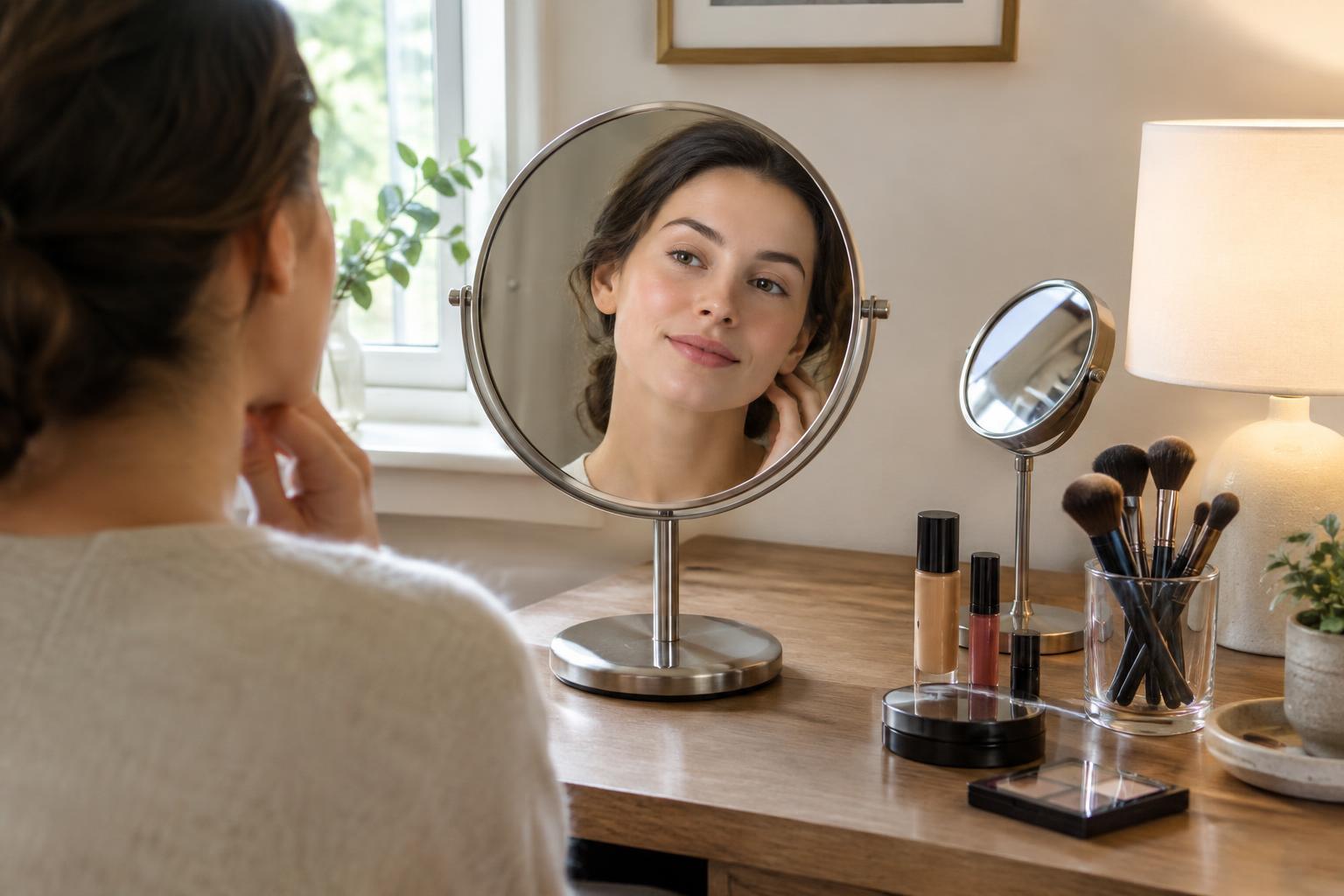
The best makeup mirror is the one that fits where you get ready and lets you see your face comfortably. Before choosing a style, notice whether you usually stand at a bathroom counter, sit at a desk or move between rooms. A wall-mounted mirror saves counter space, while a freestanding mirror is easier to reposition. If you often get ready in more than one place, a compact folding mirror may be more useful than a large fixed one.
Check the mirror’s height and angle as well as its width. You should be able to look straight ahead without leaning over the counter or lifting your chin. A wider mirror makes it easier to compare both sides of your face when applying blush or checking brow shape. A smaller mirror can work well for close tasks, but you may still want access to a larger mirror for an overall look.
Use magnification for detail, not the whole routine
A standard mirror gives you the most familiar view of your makeup. Magnification can help with tasks such as placing eyeliner, grooming brows or checking the edge of a lip color, but it also makes normal skin texture look more prominent. That close view is useful for precision; it is not necessarily a helpful guide to how your makeup looks at a conversational distance.
If you choose a two-sided mirror, use the magnified side briefly and return to the standard side before you finish. Test the viewing distance if you can: some magnified mirrors require you to sit quite close to keep the image clear. A mirror that is awkward to reach or constantly needs adjusting may interrupt your routine more than its extra detail helps.
Aim for even light across your face
Lighting matters because shadows can make it difficult to judge where you have blended product. A single bright bulb above your head may cast shadows beneath your eyes and nose. A lamp directly below your face can do the opposite. If possible, place light in front of you, near face height, with illumination reaching both sides of your face. Two modest light sources on either side of a mirror can be more useful than one harsh source.
Diffused light is generally easier to work with than a bare bulb shining into the mirror. A shade, frosted cover or light directed toward a pale wall can soften glare. If you use daylight from a window, face the window rather than placing it behind you. Daylight changes as the day goes on, so an adjustable lamp can provide a steadier option when you get ready early or late.
Choose lighting you can live with
Look for a light that lets you see colors clearly without feeling uncomfortably bright. Very warm light may make foundation and blush appear different when you step outside, while an unusually cool light can also change how colors look. A balanced white light is a practical starting point. If a lighted mirror offers several color settings, compare them with the lighting you encounter most often rather than treating one setting as universally correct.
Brightness control is useful, especially if the same space is used at different times of day. Turn the light up for detailed work, then lower it to check the overall effect. If you can, take one final look in another familiar light source, such as near a window or in the room where you will spend time. This quick check can reveal an obvious blending line or a color that looked different at the mirror.
Make the setup easy to maintain
A useful station does not need many pieces. Keep the mirror stable, leave enough clear space for the products you use most and position cords where they will not cross your work area. For a small surface, an adjustable lamp and an ordinary mirror may offer more flexibility than a bulky lighted mirror. If you prefer a lighted mirror, consider how easily you can tilt it, clean it and access its controls.
Clean the mirror regularly with a suitable cloth so fingerprints and powder do not obscure detail or make the light seem dull. Then pay attention to how the setup works during an ordinary routine. If you keep moving your head to escape glare, shift the light. If one cheek always appears darker, adjust the placement. Small changes in angle and position often make a mirror more useful than adding another tool.