Start with the bag’s position
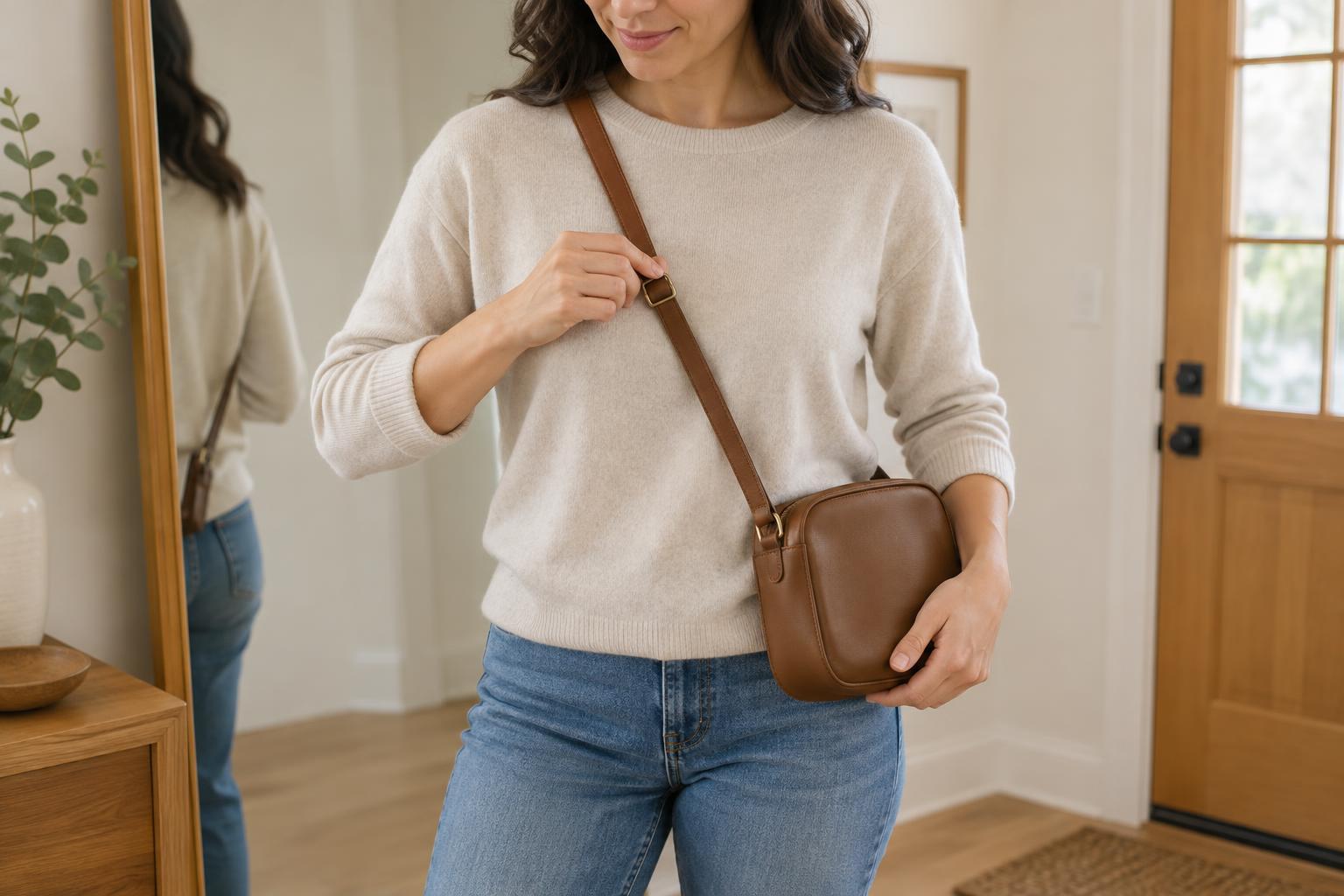
Put the bag on with the strap crossing your torso and the bag resting at the opposite side. As a starting point, aim for the bag to sit around your upper hip. You should be able to reach its opening without lifting your shoulder, bending far to one side, or pulling the bag across your body. There is no single correct height: a small bag may feel comfortable higher up, while a larger bag may be easier to carry a little lower.
Stand naturally before changing the strap. If the bag sits against your ribs and crowds your arm, lengthen the strap slightly. If it bumps your thigh or swings widely when you walk, shorten it. Make one small adjustment at a time, then walk a few steps and sit down. A fit that looks right in a mirror may feel different in motion.
Adjust the strap without twisting it
For a strap with a sliding buckle, hold the buckle steady and feed a little webbing or leather through it. Pull the loose section to shorten the strap, or ease more material through to lengthen it. Check that the strap lies flat from your shoulder to the bag; a twist can create a narrow pressure point and make the bag hang unevenly. If the strap has holes and a pin buckle, choose the nearest setting that allows comfortable movement rather than forcing a tight fit.
After adjusting, check both ends where the strap attaches to the bag. Clips should be fully closed, and any adjustable tail should sit securely in its keeper loop if there is one. Avoid tying a knot in a strap just to make it shorter unless the bag is designed for that method. A knot can be bulky, may slip, and can leave marks on some materials.
Test the fit with your usual belongings
An empty bag often hangs differently from one holding a phone, keys, wallet, and other everyday items. Add what you normally carry, then walk, turn, reach for something, and sit down again. The bag should stay reasonably close to your body without pressing uncomfortably into your side. If it pulls at one shoulder, first check whether the contents are unevenly packed or heavier than the bag comfortably carries.
Notice where the bag lands when you open it. If you have to hold the bag up with one hand every time you use it, try a slightly shorter setting. If the strap feels restrictive when you reach forward, give it a little more length. The goal is a useful middle ground: accessible when you need it and settled when your hands are free.
Account for clothing and activity
A strap adjusted over a T-shirt may feel short over a thick sweater or coat. Try the bag with the layers you wear most often, and expect to make a small seasonal adjustment. Also check that the strap does not catch on a collar, scarf, or prominent buttons. If you wear a delicate fabric, a smooth strap and carefully placed hardware may help reduce snagging.
Your preferred length may change with the day’s plans. A slightly shorter strap can limit swinging during a brisk walk or a crowded commute. A slightly longer one may make it easier to take the bag on and off over outerwear. If you switch which shoulder carries the strap, retest the position rather than assuming it will hang exactly the same way.
Know when the strap is the problem
If the bag still feels awkward after several small adjustments, consider the strap itself. A very narrow strap may feel less comfortable with a heavier load, while a wide or stiff strap may rub near the neck on some people. A compatible replacement strap with an appropriate width and secure attachments may offer a better fit. Check the bag’s attachment style and the strap’s adjustment range before choosing one.
Finally, use comfort as your guide rather than trying to match a particular look. The bag should not repeatedly slide off your shoulder, pull sharply across your neck, or interfere with your stride. Once you find a setting that works, take note of the buckle position or strap hole. That makes it easier to return to your preferred fit after sharing the bag or adjusting it for a different outfit.